Tutorial 2b — Heat Network Integration#
This tutorial extends the brownfield plant from Tutorial 2 — Brownfield & Process Constraints by putting heat at the centre of the analysis. The key question: when a large electrolyser produces substantial waste heat, what is the best way to collect, store and sell it?
The setup adds three heat-side technologies to the existing plant:
Heat pump — upgrades low-temperature electrolyser waste heat (30–60 °C) to district-heating supply temperature (≈ 70–90 °C).
District-heating water-tank storage (TES DH) — a thermal buffer that decouples heat production from DH demand, allowing the plant to exploit cheap electricity hours without oversizing the DH connection.
DH connection — sells heat to the district-heating grid at a fixed price of 100 €/MWh.
The electrolysis plant is fixed at 100 MW (a larger unit than Tutorial 2) to generate the waste heat that makes the heat-network economics interesting.
—
1 · Run it#
cp tutorials/2_brownfield_heat/config.yaml   config/config.yaml
cp tutorials/2_brownfield_heat/n_config.yaml config/n_config.yaml
snakemake --cores 4
python tutorials/2_brownfield_heat/plot_heat_network.py   # topology + DH demand figures
Key config choices (config.yaml,
n_config.yaml):
targets:
  driver: demand
  demand_H2: 580000   # MWh/y — large hydrogen demand drives a big electrolyser
  demand_CH4: 262000  # MWh/y biomethane
  demand_meoh: 0

n_flags:
  meoh: false         # methanol synthesis switched off

options:
  DH:
    enable: true
    price: 100        # €/MWh paid for heat delivered to DH
    peak capacity: 80 # MW DH system peak
The biogas, wind, solar and electrolysis units are all existing brownfield assets. Only biogas upgrading, the heat pump and the TES are allowed to expand.
—
2 · The heat-network topology#
The plot_heat_network.py script generates a topology diagram of the heat
subsystem, showing all buses with “Heat” or “DH” in their name and their
one-hop neighbourhood:
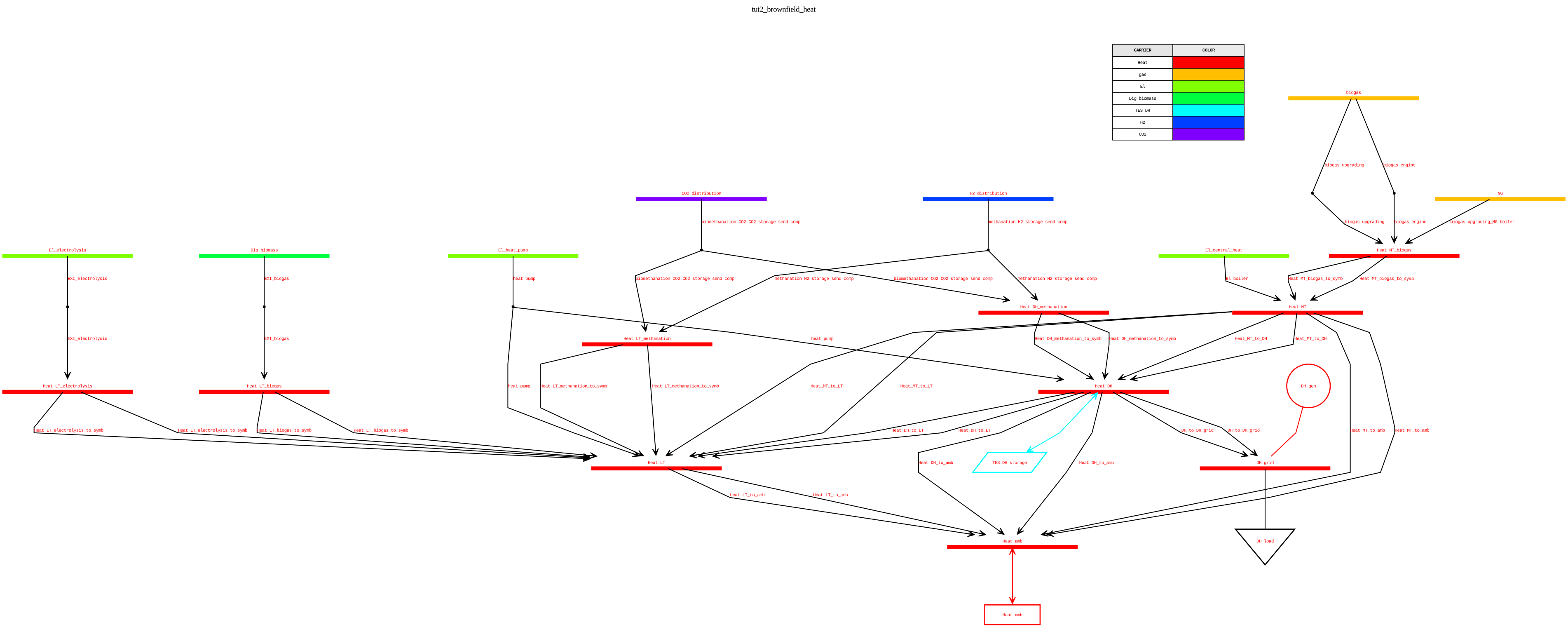
Heat-network topology. Electrolyser waste heat (low-temperature, LT) flows through the heat pump to reach district-heating temperature (DH bus), then to the DH grid or to the TES buffer. The biomass and NG boilers provide backup medium-temperature heat (Heat MT).#
The DH demand profile is temperature-driven: it peaks in winter and drops to a small sanitary-water base load in summer.
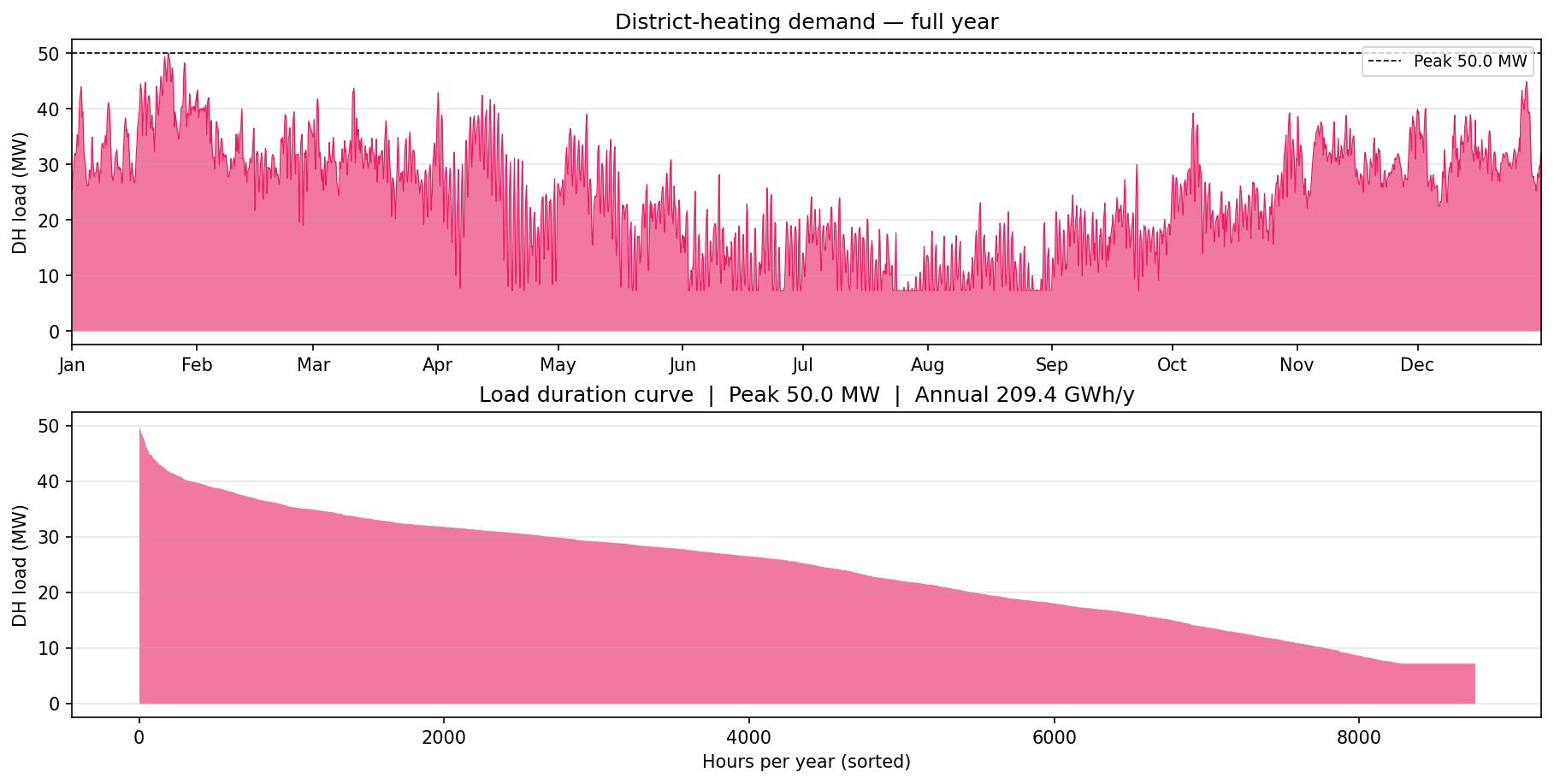
DH demand time series (top) and load-duration curve (bottom). Peak demand ≈ 50 MW, annual supply ≈ 222 GWh/y.#
—
3 · Interpret the results#
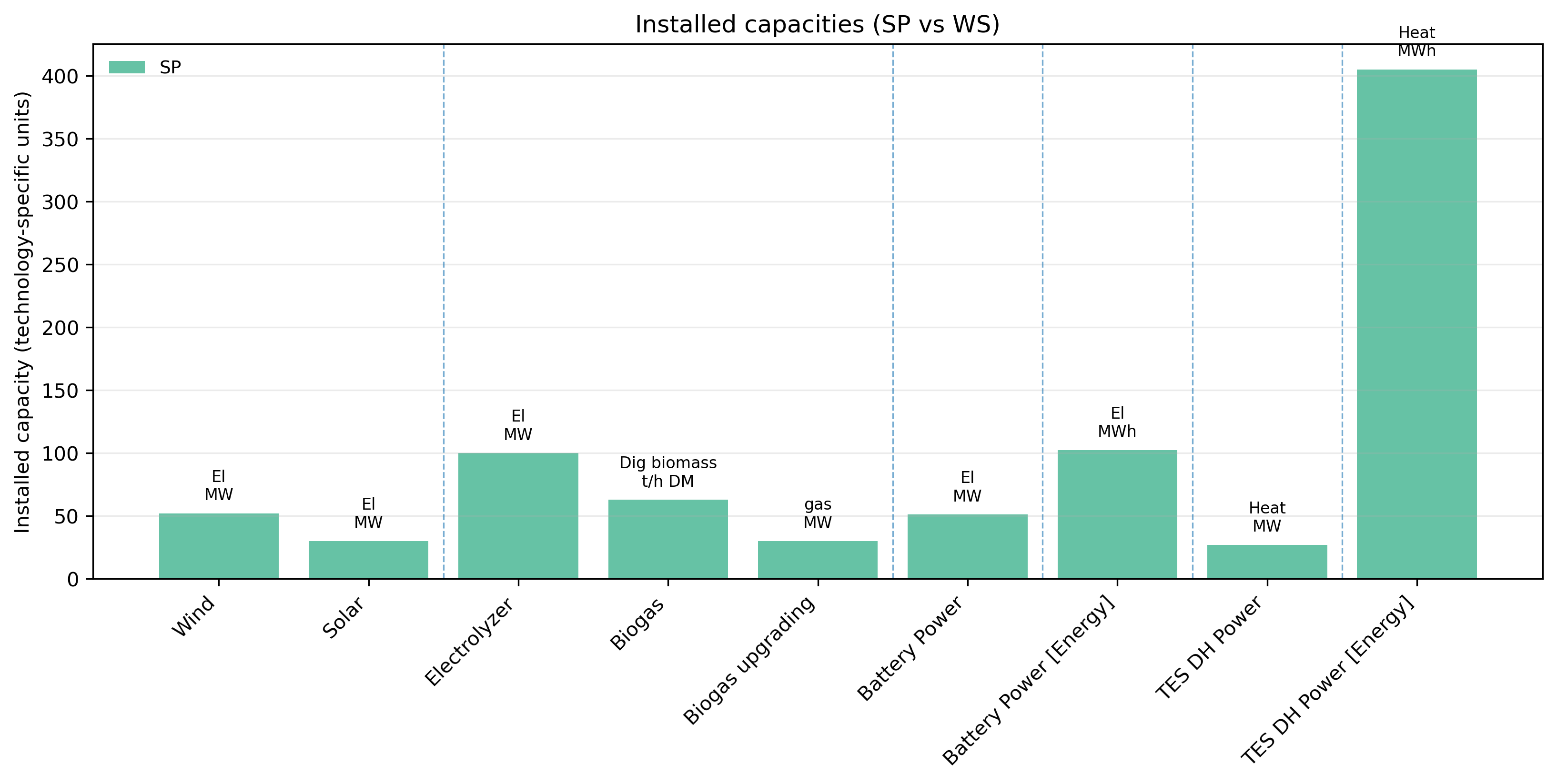
Optimal investments. The electrolyser (100 MW, fixed EXI), wind (52 MW) and solar (30 MW) are brownfield. The model adds biogas upgrading 29.9 MW, battery 51.1 MW / 102.3 MWh and crucially TES DH 27 MW / 405 MWh (15 h of thermal storage at peak power).#
Key heat results
TES DH: 27 MW / 405 MWh. The thermal storage is sized to shift about half a day of DH supply. Its capacity factor is low (CF ≈ 0.05) — it acts as a peak-shaving buffer rather than a baseload asset, absorbing excess heat during high-renewable hours and releasing it when the heat pump is idle.
Heat pump CF ≈ 0.72. The heat pump runs intensively during cheap electricity hours, converting low-temperature electrolyser waste heat into district-heating supply. It is the key link between the electricity and heat networks.
Battery 51.1 MW / 102.3 MWh. A much larger battery than Tutorial 2 (2.7 MW) because the 100 MW fixed electrolyser creates large and variable electricity demand spikes that the battery smooths against the renewable profile.
District heating revenue ≈ €20.9 M/y — the largest single revenue stream after biomethane, reflecting the high DH price (100 €/MWh) and the 222 GWh/y annual supply.
The high H₂ shadow price (340 €/MWh at H₂ delivery) reflects the cost of a large fixed electrolysis investment amortised over the demand volume.
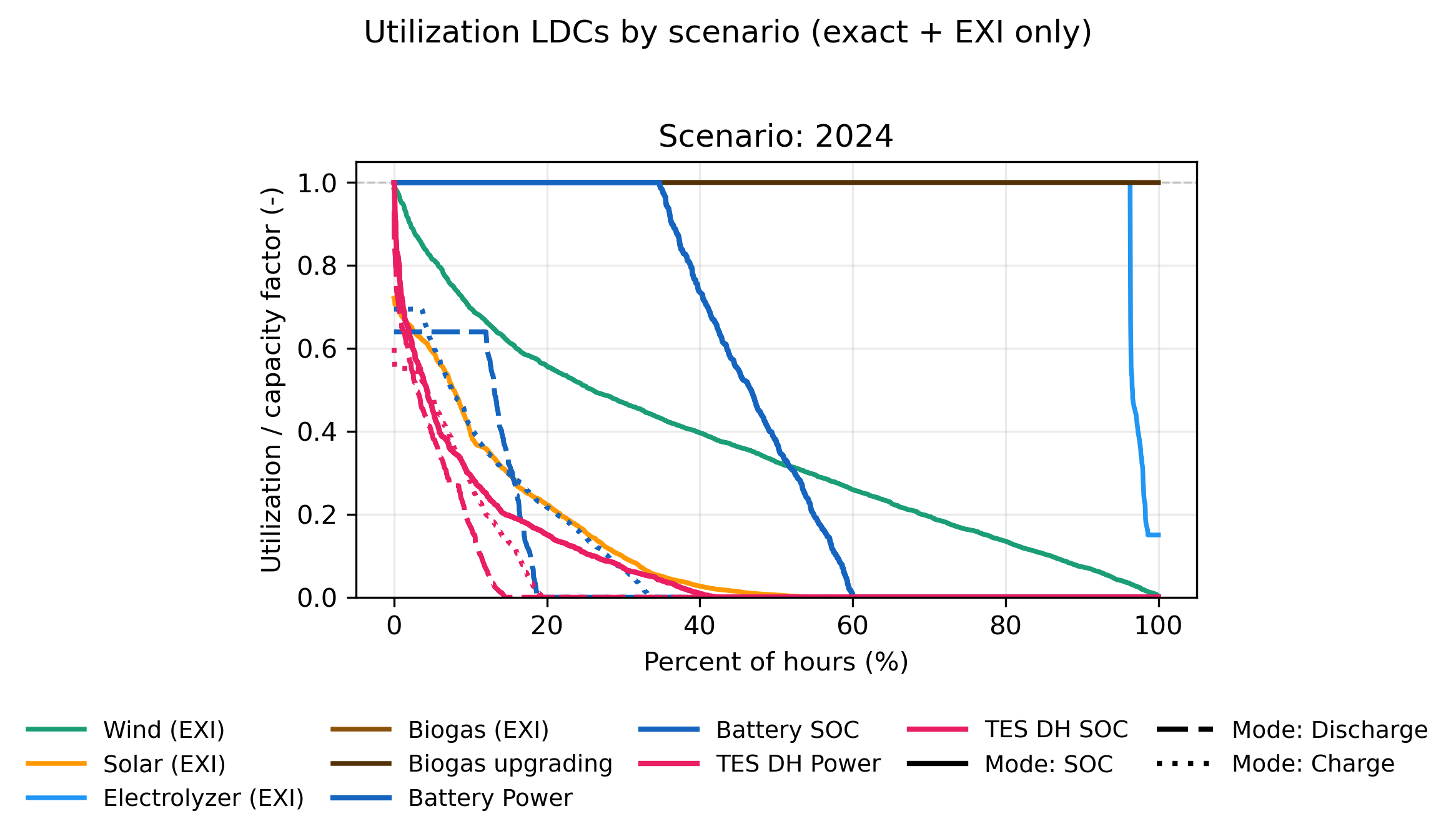
Per-component utilization duration curves. The electrolyser runs near constantly (CF 0.97), the heat pump follows with CF 0.72, and the TES DH smooths the seasonal mismatch between heat production and demand.#
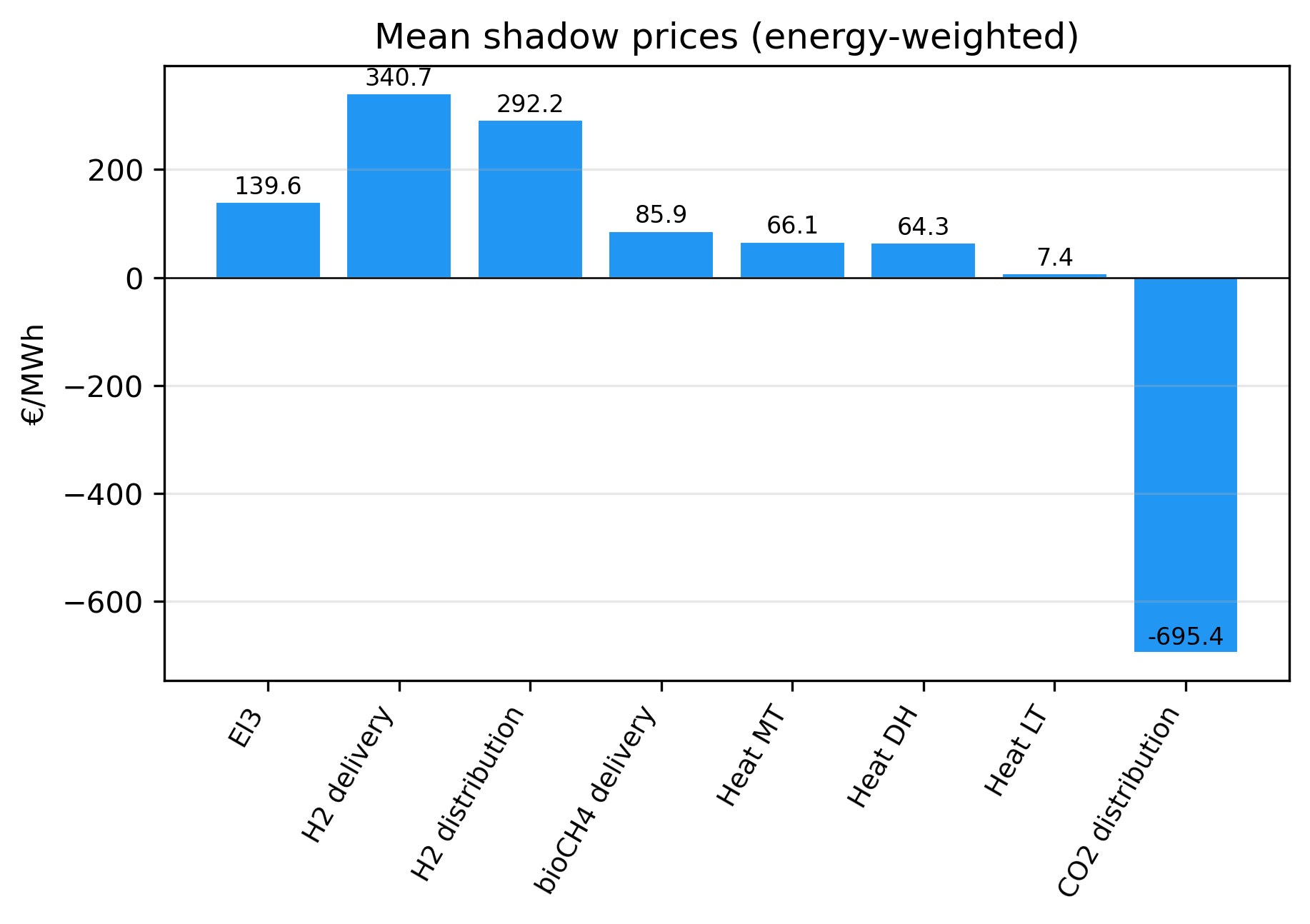
Energy-weighted mean shadow prices and annual throughput at internal carrier buses. The electricity bus (El3) clears at ≈ 140 €/MWh (high, reflecting the large fixed electrolysis CAPEX). Heat DH ≈ 64 €/MWh, Heat MT ≈ 66 €/MWh. CO₂ distribution has a negative shadow price (surplus CO₂ not fully absorbed by biomethanation).#
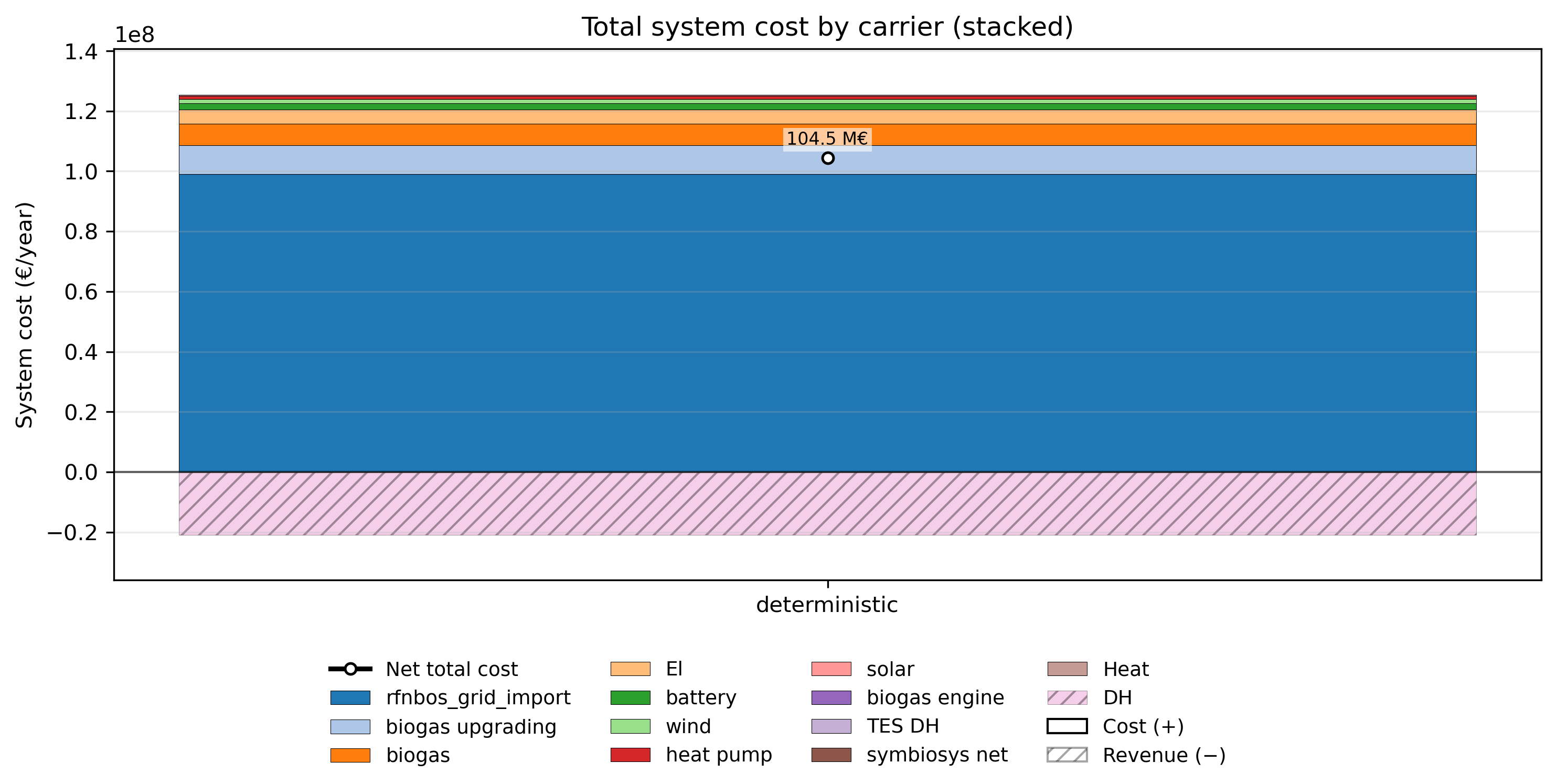
Total system cost by carrier. The dominant cost is the fixed electrolysis CAPEX + large H₂ demand. District-heating revenue (≈ €20.9 M/y) partially offsets the heat-side investments.#
—
What you learned#
How electrolyser waste heat flows through a heat pump into a DH network.
Sizing a thermal energy storage (TES) as a peak-shaving buffer — low CF but high value for decoupling heat production from the seasonal DH profile.
How heat-side investments (pump, TES, DH connection) interact with electricity storage (battery) when the RE profile drives both.
The impact of a high DH off-take price on overall plant economics.